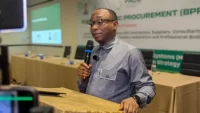


The National Centre for Technology Management (NACETEM) is an agency of the Federal Ministry of Innovation, Science, and Technology (FMIST). It actively engages in the capacity building of technological expertise, technology management, and policy R&D, as well as sustainable management of science, technology, and innovation (STI).
These various activities of the Centre deserve awareness being created on them and their impacts on the larger society.
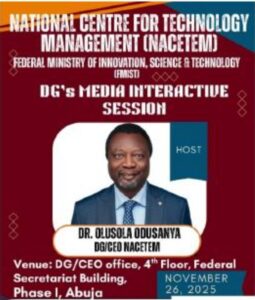
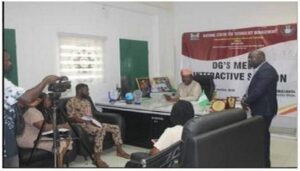
Hence, the DG/CEO of NACETEM Dr. Olushola Odusanya held an interactive session with media stakeholders on the 26th of November, 2025. The program featured the DG’s remarks, questions and answers session, and interactive moment with journalists from five major media (both print and broadcast) organisations in Nigeria.
At the event, the DG stated that NACETEM has positioned itself at the forefront as a lead organisation in the national artificial intelligence (AI) dialogue. NACETEM has been leading several AI research and practical initiatives within Nigeria’s emerging AI landscape, as well as championing policy conversations aimed at ensuring the country does not lag behind in the global technological transition. The Centre is actively shaping AI policy frameworks that balance innovation with ethics, inclusion, and competitiveness.
“We are leading Nigeria’s AI policy dialogues to ensure our nation is future-ready,” he said. “Innovation must align with national interests, global competitiveness, and the responsible use of technology.”
The Director-General explained that NACETEM’s roles include advising government on emerging technologies, developing evidence-based policy guidance, and reinforcing the country’s preparedness for fast-evolving sectors such as renewable energy, fintech, and digital entrepreneurship.
He also mentioned that NACETEM is strengthening partnerships across academia, research institutions, and industry stakeholders to build an innovation ecosystem capable of driving national development. He underscored NACETEM’s commitment to positioning Nigeria for a technology-driven future.
In furtherance of this mandate, the Centre has launched industry-aligned welding programmes aimed at equipping Nigerian youths with globally competitive skills. The initiative integrates modern welding techniques with emerging technologies such as virtual reality and robotics to produce internationally certified professionals.
“Welding is now a highly technical and well-paid profession worldwide. Our goal is to prepare Nigerian youths to work anywhere in the world,” Dr. Olushola Odusanya told journalists at the event.
To date, NACETEM has issued over 1,150 welder test certifications, with additional training phases scheduled throughout 2026 to expand opportunities for young Nigerians. The Centre also offers specialised training, including underwater welding, to meet high-demand skill needs in the oil, gas, and marine sectors.
Beyond welding, NACETEM recently announced a nationwide programme aimed at training one million Nigerians over the next five years in critical competencies required for socio-economic development. The initiative focuses on technology management, innovation systems, and entrepreneurship, reflecting the Centre’s strategic objective of preparing Nigerians for participation in a knowledge-driven economy.
Highlighting the broader skills landscape, Dr. Odusanya emphasised the importance of strengthening vocational education and technical training across the country. He advocated for the re-introduction of education policies that allocated 60 per cent of secondary school studies to science and 40 per cent to arts in order to cultivate more scientists, engineers, and technology-driven entrepreneurs.

According to him, four technical skills—welding, foundry, industrial electrical work, and industrial mechatronics—are critical to Nigeria’s industrial growth. When combined with ICT competencies, these skills are essential to maximising the benefits of the country’s industrialisation efforts.
To further enhance efficiency and transparency, NACETEM has fully digitised its core activities such as internal operations, staff performance management, products/services, and training programs, e.g., NACETEM Academy (online). These reforms, alongside others mentioned earlier, are designed to enhance NACETEM’s capacity to catalyze a robust national innovation ecosystem, promote technology transfer, and revitalise Nigeria’s research and development landscape.
In his concluding remarks at the media session, after various interactions with the journalists, Dr. Odusanya urged members of the media as well as other public and private sector stakeholders to actively support NACETEM’s initiatives. He encouraged journalists to engage with the Centre, verify information through official channels, and partner with NACETEM in advancing a shared vision of a knowledge-driven, technology-ready, and globally competitive Nigeria.
- NACETEM Communications Team